

Leadership is not about holding a title—it’s about cultivating certain ways of thinking, behaving, and responding. To answer what mindset makes a great leader, here are 7 leadership mindset traits that lead to success in any organization.
7 Key Mindsets Every Leader Needs
1. Growth mindset for leaders
Leaders who believe skills and intelligence can be developed are more likely to take on challenges, embrace feedback, and persist in the face of setbacks. Google’s Project Oxygen found that managers with a growth mindset outperform those with a fixed mindset in team morale and effectiveness.
2. Visionary leadership mindset
Great leaders see beyond immediate tasks—they build vision and strategy. This mindset helps align the team, anticipate change, and inspire others. When a leader thinks ahead, the team knows not just what to do, but why it matters.
3. Adaptive Leadership Mindset
In contexts that rapidly shift (technology, markets, remote work), rigid thinking lacks utility. An adaptive leadership mindset promotes tactical flexibility, continuous learning, and the ability to pivot when necessary. The adaptive leadership mindset integrates well with a resilient leader mindset since both are focused on flexibility and recovering from a setback.
4. Empathy in Leadership & Leading with Humility Mindset
Leaders who listen, sincerely care, and act with humility often engender trust. An empathetic leader understands the team’s emotional state; humility reminds them of their shared space—they are part of the team, not above it. These other-oriented traits typically garner greater engagement and loyalty.
5. Decision-making mindset & Accountability mindset for leaders
Making clear, timely decisions and taking responsibility for the results is essential. An accountability mindset ensures that leaders accept ownership of the results (good and bad) and establish a standard for others to follow.
6. Strategic thinking as a leader & Innovative leadership mindset
Thinking strategically also considers looking outside more broadly, trends, risks and opportunities. Pair that with innovation—testing out different approaches and creating opportunity for others to be innovative—and leaders can achieve growth, anticipate trends, and move toward continuous improvement.
7. Learning mindset for leadership & Mindfulness in leadership
Leadership is a continuous process of learning on your part as a leader about new knowledge, skills and insights. When you are engaged in ongoing mindful learning, you maintain optimal awareness, less reactivity and self-regulation. Mindful leadership improves decision quality and team atmosphere.
Comparing Leaders vs Managers Mindset
- The mindset of a leader vs a manager: If you are a manager, you may focus more on processes, tasks, and unchanging; leaders focus more on vision, transformation, inspire the team, and growth.
- The shift from manager to leader often requires a mindset shift for leadership success—from controlling to empowering; from fixed goals to adaptive objectives.
Why These Mindsets Matter
- Leadership that models a positive mindset encourages motivation, lessens resistance to change, and builds team morale.
- A resilient leader mindset allows for challenges to be met—leaders who can positively overcome setbacks can prevent burnout and keep things moving forward.
- Together, leaders’ mindsets (growth, adaptive, accountability, etc.) establish a safe environment for people to create, learn, and contribute.
Examples of Leader Mindset
- A CEO of a startup who hears what customers are saying, sees that product-market fit is not exact, and changes their approach (adaptive + growth mindset).
- A manager within a large company who can admit to mistakes, who will thank coworkers for their assistance, and who moderates accordingly (leading with humility mindset + empathy).
- A leader who regularly sets aside time to have “learning sessions” for themselves and their team—read the latest research and experimentation, and then reflect (learning mindset for leadership + strategic thinking).
How to Develop These Mindsets
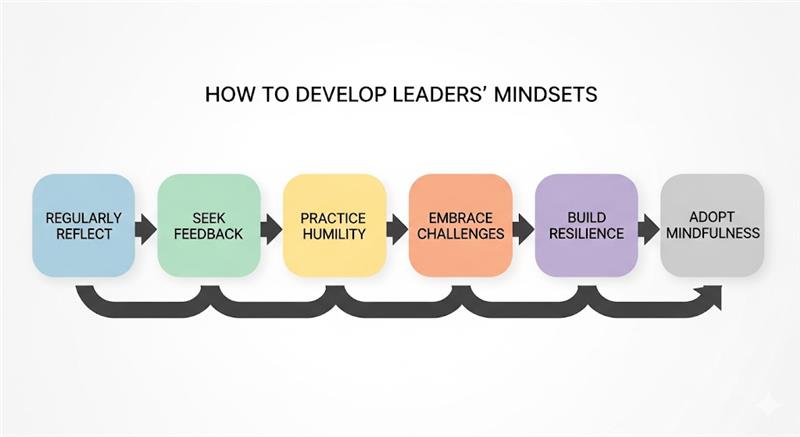
- Regularly Reflect: Journal about what went well/wrong and what you learned.
- Seek Feedback: from peers, team, external mentors.
- Practice Humility: Own mistakes, share credit.
- Embrace Challenges: take on tasks beyond your comfort zone.
- Build Resilience: Failures are simply lessons.
- Adopt Mindfulness: small daily practices (breath, meditation, or simple pauses) to bring more awareness.
FAQ
What mindset do leaders need to succeed?
Leaders need a combination of growth, adaptive, resilient, visionary, and accountability mindsets.
How to develop a leadership mindset?
By self-reflection, obtaining feedback, continuous learning, leaning into challenges, and methods such as mindfulness.
How leaders think differently from managers?
Leaders create visions, inspire others and flex; managers preserve, coordinate and stabilize operations.
How does empathy make a leader more effective?
Empathy builds trust, enhances communication, contributes to conflict resolution, and results in increased team satisfaction.
What are the qualities of a writer’s mindset of a visionary leader?
Consider future possibilities, strategic thinker, innovative mindset, inspires others to act, mindset of courage.
Key Takeaway
Effective leadership is not one mindset, it is a balanced set of mindsets that includes growth, vision, adaptability, empathy, accountability, learn, and humility. When you cultivate these mindsets, it will not only change who you are as a leader, but it will also greatly change how your team performs.
Tools and platforms such as HCIL.live can support this journey by offering insights, assessments, and training to help leaders practice these mindsets consistently.